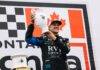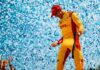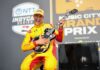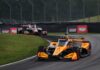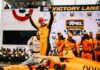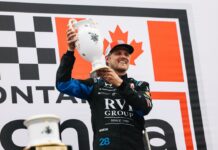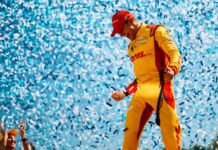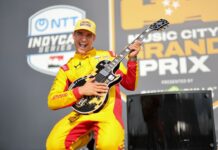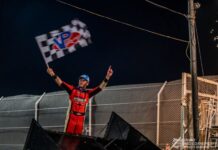

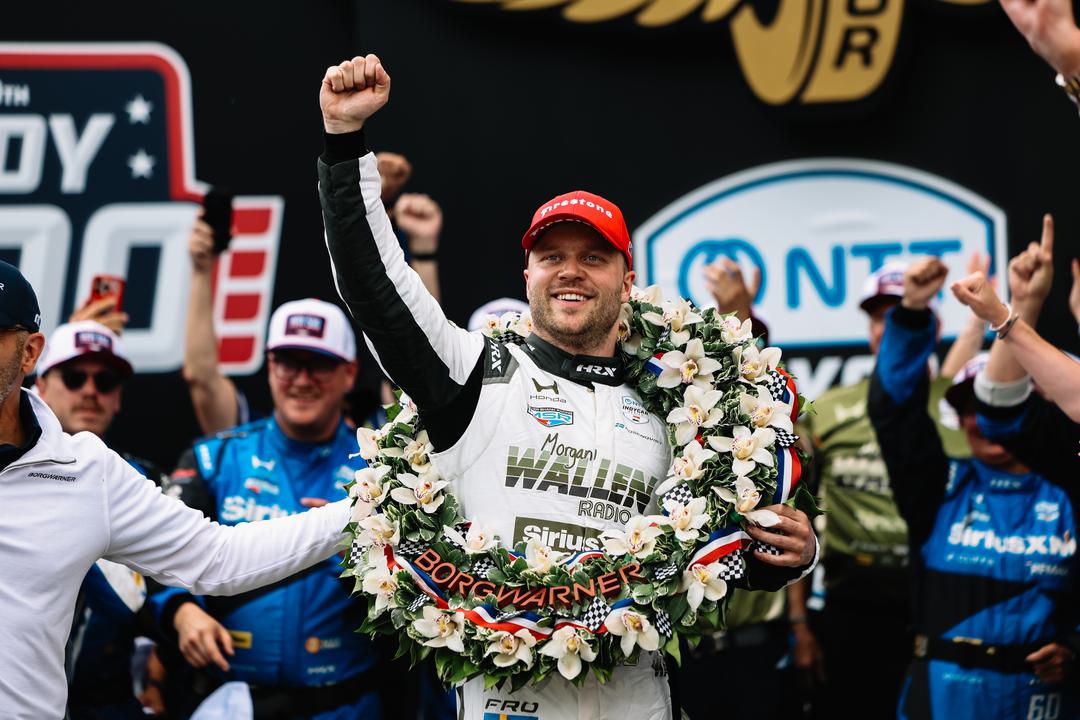
Felix Rosenqvist delivered one of the greatest final laps in Indianapolis 500 history, passing David Malukas just yards before the Yard of Bricks to win the 110th Running of the Indianapolis 500.
Rosenqvist crossed the finish line only 0.0233 seconds ahead of Malukas, establishing the closest finish in the history of “The Greatest Spectacle in Racing.” The victory was Rosenqvist’s first Indianapolis 500 win and only the second NTT INDYCAR SERIES victory of his career.
The 200-lap race featured an event-record 70 lead changes among 14 drivers, seven caution periods, two red flags and a dramatic final restart that turned the running order upside down.
Rosenqvist Charges from Third to First on Final Lap
The closing stages developed into a battle between two groups operating on dramatically different strategies.
Rosenqvist, Pato O’Ward and Marcus Armstrong made their final pit stops between laps 164 and 166, placing them at the edge of the fuel window. Malukas, Scott McLaughlin and pole-sitter Alex Palou stayed out longer, making their final stops approximately 10 laps later and using their additional speed to close the gap.
O’Ward initially controlled the fuel-saving group, but Rosenqvist moved around the Arrow McLaren driver for the lead on lap 185. With enough fuel to reach the finish and the chasing group still more than 20 seconds behind, Rosenqvist appeared positioned to cruise to victory.
That advantage disappeared when rookie Caio Collet crashed heavily in Turn 2 on lap 192. The impact brought out a caution and red flag, eliminating the separation between the competing strategies.
Rosenqvist led the field back to green on lap 196, but Armstrong charged around the outside during a four-wide battle into Turn 1. Malukas followed Armstrong through, dropping Rosenqvist to third.
The race was stopped again almost immediately when rookie Mick Schumacher brushed the SAFER Barrier in Turn 2 on lap 197.
INDYCAR restarted the race with one green-flag lap remaining.
Armstrong led the field to the white flag, but Malukas pulled alongside entering Turn 1 and moved into the lead. Rosenqvist followed him through while battling Armstrong and O’Ward behind them.
Malukas appeared to have created enough separation on the backstretch, but Rosenqvist remained within striking distance. Rosenqvist carried his momentum around the outside of Turn 4 and closed rapidly as Malukas moved across the frontstretch attempting to break the aerodynamic tow.
Rosenqvist moved back toward the outside wall, pulled alongside the Team Penske Chevrolet and edged ahead just before the finish line.
Only 0.0233 seconds separated the two drivers, breaking the previous Indianapolis 500 record of 0.043 seconds set when Al Unser Jr. defeated Scott Goodyear in 1992.
McLaughlin finished third, only 0.4205 seconds behind Rosenqvist. O’Ward crossed the line alongside him in fourth, while Armstrong completed a three-wide fight for the final podium position and finished fifth.
The top five were separated by only 0.4360 seconds.
2026 Indianapolis 500 Top 10
- Felix Rosenqvist, No. 60 Meyer Shank Racing Honda
- David Malukas, No. 12 Team Penske Chevrolet
- Scott McLaughlin, No. 3 Team Penske Chevrolet
- Pato O’Ward, No. 5 Arrow McLaren Chevrolet
- Marcus Armstrong, No. 66 Meyer Shank Racing Honda
- Rinus VeeKay, No. 76 Juncos Hollinger Racing Chevrolet
- Alex Palou, No. 10 Chip Ganassi Racing Honda
- Santino Ferrucci, No. 14 A.J. Foyt Enterprises Chevrolet
- Romain Grosjean, No. 18 Dale Coyne Racing Honda
- Takuma Sato, No. 75 Rahal Letterman Lanigan Racing Honda
Performance Highlights
Biggest Mover: Romain Grosjean
Romain Grosjean produced one of the strongest drives of the afternoon, advancing from 24th on the starting grid to finish ninth.
Grosjean remained in contention through the race’s changing strategies and avoided the incidents that eliminated several experienced competitors. He also led three laps, marking the first time he had led the Indianapolis 500.
His 15-position improvement was the largest gain of any driver in the field.
David Malukas Comes Within Inches of Victory
David Malukas fell only a fraction of a second short of delivering Team Penske another Indianapolis 500 victory.
Malukas started third, led 30 laps and emerged as the strongest driver from the group that made a later final pit stop. His move around Armstrong on the final lap initially appeared to be the winning pass before Rosenqvist caught him approaching the finish line.
Although the result was heartbreaking, the performance established Malukas as one of INDYCAR’s leading oval competitors and moved him into second place in the championship standings following the race.
Meyer Shank Racing Places Two Cars in the Top Five
Rosenqvist’s victory was complemented by Armstrong’s fifth-place finish, giving Meyer Shank Racing two cars among the first five across the Yard of Bricks.
Armstrong made one of the most aggressive moves of the race when he charged around the outside during the lap 196 restart. He later led the field to the white flag and remained in contention until the final corners.
The result gave Meyer Shank Racing its second Indianapolis 500 victory. Remarkably, both of the team’s INDYCAR victories have come at Indianapolis, following Helio Castroneves’ fourth Indy 500 triumph in 2021.
Quietly Strong: Rinus VeeKay
Rinus VeeKay delivered the best Indianapolis 500 finish of his career, placing sixth after starting 11th.
VeeKay led eight laps and kept the No. 76 Juncos Hollinger Racing Chevrolet near the front throughout the race. While the final restart placed most of the attention on the first five drivers, VeeKay completed a clean and competitive afternoon just over one second behind the winner.
Alex Palou Leads the Most Laps
Defending Indianapolis 500 winner Alex Palou controlled significant portions of the race after starting from pole.
Palou led a race-high 59 laps and frequently traded the top position with Chip Ganassi Racing teammate Scott Dixon. The two drivers exchanged the lead 26 times, the most lead changes between the same two competitors in Indianapolis 500 history.
Palou ultimately finished seventh after the late caution erased the advantage held by the drivers on his strategy. His No. 10 team was later penalized five championship points and fined after the car failed a front-wing height measurement during post-race inspection.
Crashes, Mechanical Failures and Near-Misses
The first major accident occurred on lap 18 when Ryan Hunter-Reay lost control in Turn 2. Katherine Legge attempted to avoid the spinning car but was collected in the incident, ending both drivers’ races.
The crash also ended Legge’s opportunity to complete all 1,100 miles of the Indianapolis 500 and Coca-Cola 600 on the same day.
Ed Carpenter’s race ended shortly afterward when he crashed on lap 26. Carpenter was making his 23rd Indianapolis 500 start, extending the record for the most starts without a victory.
Alexander Rossi, who started from the outside of the front row, retired after 91 laps following a fire. Will Power also exited after 91 laps with a gearbox problem.
Josef Newgarden charged forward from 23rd but crashed during a restart on lap 124. The incident ended his attempt to earn a third Indianapolis 500 victory in four years.
Collet’s heavy Turn 2 accident on lap 192 became the defining caution of the race. The rookie had been running competitively before the crash erased the strategic gaps and created the late restart.
Schumacher then made contact with the wall on lap 197 but was able to continue. He finished 18th and was the highest-finishing rookie.
Helio Castroneves retired with a mechanical problem after completing 194 laps. Earlier in the race, the four-time winner surpassed A.J. Foyt as the Indianapolis 500’s all-time mileage leader.
What the 2026 Indianapolis 500 Means
Rosenqvist’s victory demonstrated once again that the Indianapolis 500 cannot be controlled through speed or strategy alone.
His team successfully placed him in position to win through fuel conservation, only to see that advantage erased by the late caution. Rosenqvist then recovered from third place on the final restart and completed two passes on the final lap, including the winning move only yards before the finish line.
Rosenqvist became the third Swedish driver to win the Indianapolis 500, joining Kenny Brack and Marcus Ericsson. He also became the first driver to win the race in car No. 60.
For Malukas, the result will be remembered as one of the narrowest defeats in Indianapolis history. However, his speed, composure and final-lap execution showed that he is capable of returning as a favorite in future editions.
O’Ward recorded his fifth top-four finish in seven Indianapolis 500 starts but once again left the Speedway without the victory that has repeatedly appeared within reach.
The record 70 lead changes, the tight competition between Honda and Chevrolet and the final five-car battle showed that the current Indianapolis package can produce passing throughout the field while keeping multiple strategies viable.
Most importantly, the 110th Indianapolis 500 delivered a finish that will be replayed for decades.
Rosenqvist entered Turn 4 in third place, exited it with a chance and crossed the Yard of Bricks as an Indianapolis 500 champion.